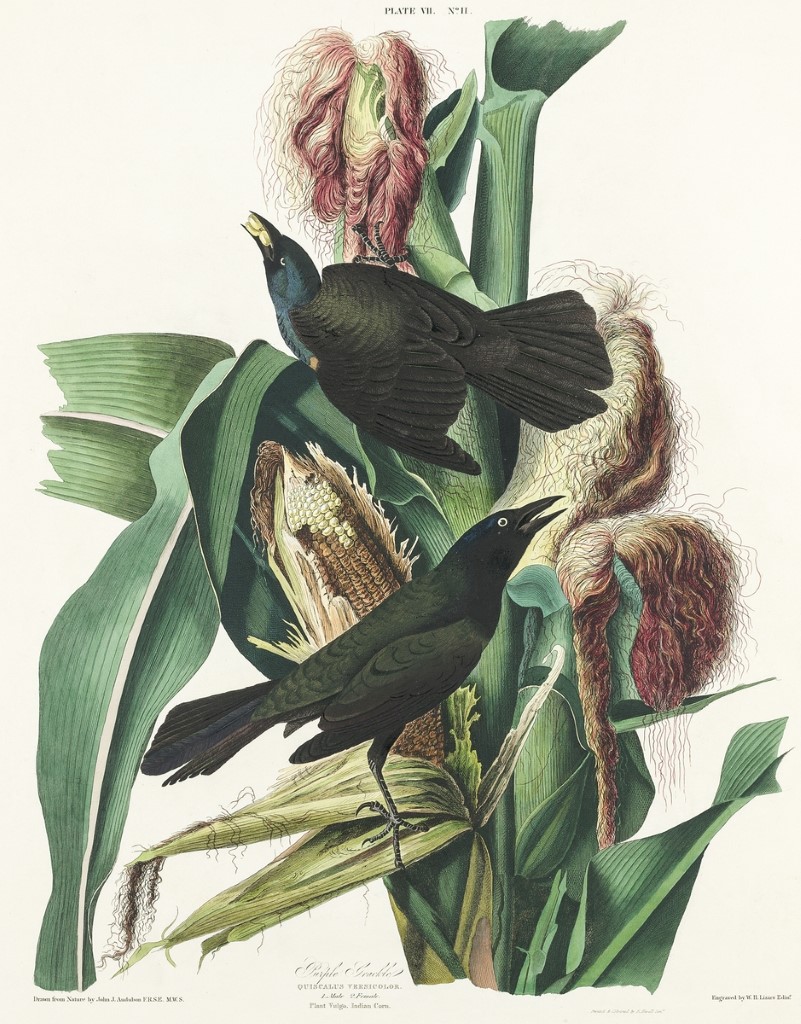
The common grackle (Quiscalus quiscula) is a species of large icterid bird found in large numbers through much of North America. First described in 1758 by Carl Linnaeus, the common grackle has three subspecies. Adult common grackles have a long and dark bill, pale yellow eyes, and a long tail. Adults often have an iridescent appearance on their head, especially males. Common grackles can be found widely across North America east of the Rocky Mountains. Adult common grackles measure from 28 to 34 cm (11 to 13 in) in length, span 36–46 cm (14–18 in) across the wings, and weigh 74–142 g (2.6–5.0 oz). Common grackles are less sexually dimorphic than larger grackle species, but the differences between the sexes can still be noticeable. The male, which averages 122 g (4.3 oz), is larger than the female, at an average of 94 g (3.3 oz). Adults have a long, dark bill, pale yellowish eyes, and a long tail; their feathers appear black with purple, green, or blue iridescence on the head, and primarily bronze sheen in the body plumage. Adult females, beyond being smaller, are usually less iridescent; their tails in particular are shorter, and unlike the males, do not keel (display a longitudinal ridge) in flight and are brown with no purple or blue gloss. Juveniles are brown with dark brown eyes. When grackles are in a group, they are referred to as a 'plague'. (Source: Wikipedia.org, CC BY-SA)













 Dec 19, 2025