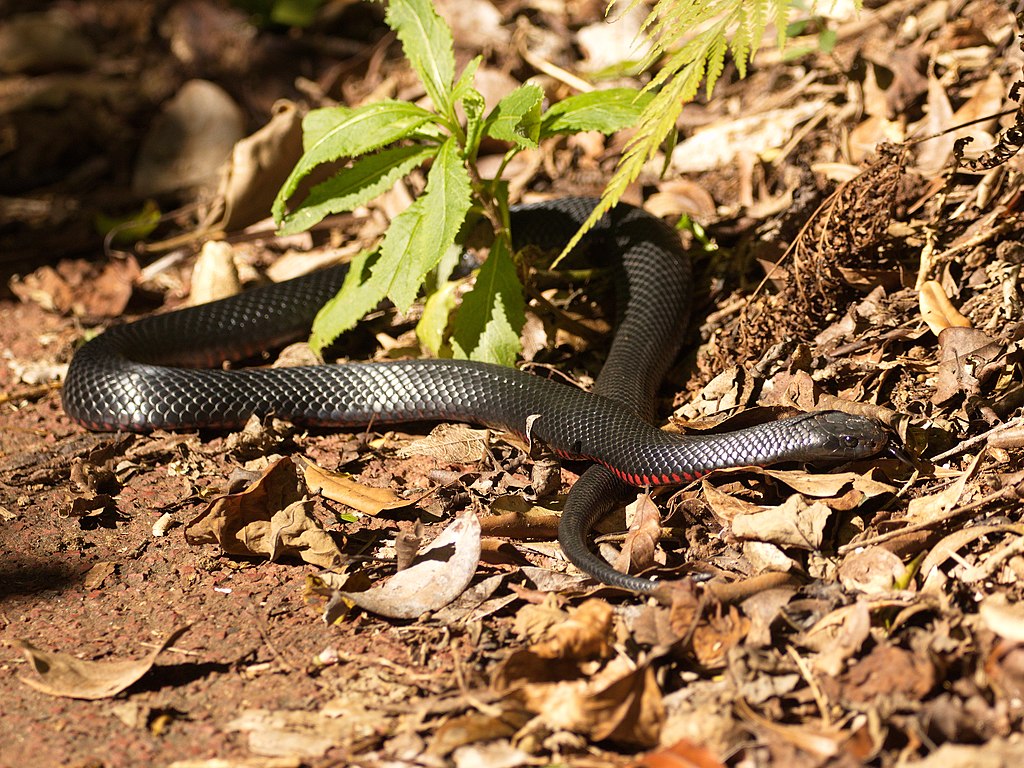
The red-bellied black snake (Pseudechis porphyriacus) is a species of venomous snake in the family Elapidae, indigenous to Australia. Originally described by George Shaw in 1794 as a species new to science, it is one of eastern Australia's most commonly encountered snakes. Averaging around 1.25 m (4 ft 1 in) in length, it has glossy black upperparts, bright red or orange flanks, and a pink or dull red belly. It is not aggressive and generally retreats from human encounters, but can attack if provoked. Although its venom can cause significant illness, no deaths have been recorded from its bite, which is less venomous than other Australian elapid snakes. The venom contains neurotoxins, myotoxins, and coagulants and has haemolytic properties. Victims can also lose their sense of smell. The red-bellied black snake has a glossy black top body with a light-grey snout and brown mouth, and a completely black tail. It lacks a well-defined neck; its head merges seamlessly into the body. Its flanks are bright red or orange, fading to pink or dull red on the belly. All these scales have black margins. Snakes from northern populations tend to have lighter, more cream or pink bellies. The red-bellied black snake is on average around 1.25 m (4 ft 1 in) long, the largest individual recorded at 2.55 m (8 ft 4 in). Males are generally slightly larger than females. A large 2 m (6 ft 7 in) specimen caught in Newcastle has been estimated to weigh around 10 kg (22 lb). The red-bellied black snake can have a strong smell, which some field experts have used to find the snakes in the wild. (Source: Wikipedia.org, CC BY-SA)












 Dec 19, 2025