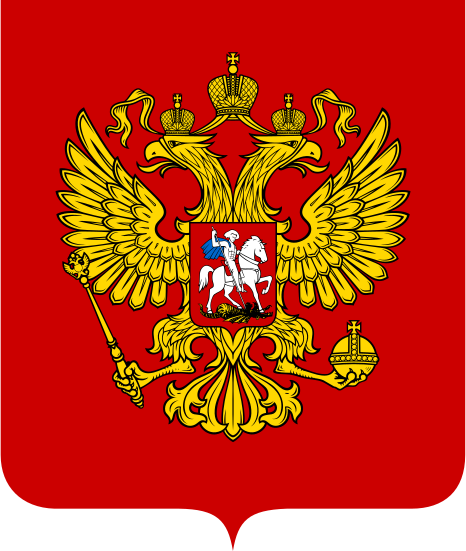
The coat of arms of Russia derives from the earlier coat of arms of the Russian Empire. Though modified more than once since the reign of Ivan III (1462–1505), the current coat of arms is directly derived from its medieval original, with the double-headed eagle having Byzantine and earlier antecedents. The general tincture corresponds to the fifteenth-century standard. Today, the imperial crowns on each head stand for the unity and sovereignty of Russia, both as a whole and in its constituent republics and regions. The orb and scepter grasped in the eagle's talons are traditional heraldic symbols of sovereign power and authority. Of note is that the scepter shows the Droste effect, as it is topped by a miniature image of the coat-of-arms itself. They have been retained in the modern Russian arms despite the fact that the Russian Federation is not a monarchy, which led to objections by the Communists even though both the blue ribbon and the collar of the Order of St. Andrew (which in the imperial arms supported the three crowns and surrounded the central shield) have been removed from the current coat of arms. (Source: Wikipedia.org, CC BY-SA)












 Mar 23, 2026