

Here you can study for the exam. Look up keywords and learn definitions about all kind of subjects.
More subjects
The national flag of the Argentine Republic is a triband, composed of three equally wide horizontal bands coloured light blue and white. There are multiple interpretations on the reasons for those colors. The flag was created by Manuel Belgrano, in line with the creation of the Cockade of Argentina, and was first raised at the city of Rosario on February 27, 1812, during the Argentine War of Independence. The National Flag Memorial was later built on the site. The First Triumvirate did not approve the use of the flag, but the Asamblea del Año XIII allowed the use of the flag as a war flag. It was the Congress of Tucumán which finally designated it as the national flag, in 1816. A yellow Sun of May was added to the center in 1818. (Source: Wikipedia.org, CC BY-SA)
The flag of Bolivia is the national flag of the Plurinational State of Bolivia. It was originally adopted in 1851. The state and war flag is a horizontal tricolor of red, yellow and green with the Bolivian coat of arms in the center. According to one source, the red stands for Bolivia's brave soldiers, while the green symbolizes fertility and yellow the nation's mineral deposits. Since 2009 the Wiphala also holds the status of dual flag in the country. According to the revised Constitution of Bolivia of 2009, the Wiphala is considered a national symbol of Bolivia (along with the flag, national anthem, coat of arms, the cockade; kantuta flower and patujú flower). Despite its landlocked status, Bolivia has a naval ensign used by navy vessels on rivers and lakes. It consists of a blue field with the state flag in the canton bordered by nine small yellow five-pointed stars, with a larger yellow five-pointed star in the fly. The nine small stars represent the nine departments of Bolivia, and the larger star the nation's right to access the sea (access that it lost in 1884 in the War of the Pacific). (Source: Wikipedia.org, CC BY-SA)
The national flag of Brazil (Portuguese: bandeira do Brasil), is a blue disc depicting a starry sky (which includes the Southern Cross) spanned by a curved band inscribed with the national motto 'Ordem e Progresso' ('Order and Progress'), within a yellow rhombus, on a green field. It was officially adopted on 19 November 1889 — four days after the Proclamation of the Republic, to replace the flag of the Empire of Brazil. The concept was the work of Raimundo Teixeira Mendes, with the collaboration of Miguel Lemos, Manuel Pereira Reis and Décio Villares. The green field and yellow rhombus from the previous imperial flag were preserved (though slightly modified in hue and shape). In the imperial flag, the green represented the House of Braganza of Pedro I, the first Emperor of Brazil, while the yellow represented the House of Habsburg of his wife, Empress Maria Leopoldina. A blue circle with white five-pointed stars replaced the arms of the Empire of Brazil — its position in the flag reflects the sky over the city of Rio de Janeiro on 15 November 1889. The motto Ordem e Progresso is derived from Auguste Comte's motto of positivism: 'L'amour pour principe et l'ordre pour base; le progrès pour but' ('Love as a principle and order as the basis; progress as the goal'). (Source: Wikipedia.org, CC BY-SA)
The flag of Chile consists of two equal-height horizontal bands of white and red, with a blue square the same height as the white band in the canton, which bears a white five-pointed star in the center. It was adopted on 18 October 1817. The Chilean flag is also known in Spanish as La Estrella Solitaria (The Lone Star). It has a 3:2 ratio between length and width, it is divided horizontally into two bands of equal height (the lower being red). The upper area is divided once: into a square (blue), with a single centered white star; and into a rectangle (white), whose lengths are in proportion 1:2. It is in the stars and stripes flag family. The star represents Venus significant to the country's indigenous Mapuches symbolizing a guide to progress and honor while other interpretations say it refers to an independent state; blue symbolizes the sky and the Pacific Ocean, white is for the snow-covered Andes, and red stands for the blood spilled to achieve independence. (Source: Wikipedia.org, CC BY-SA)
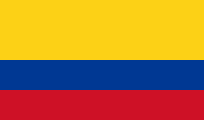
The national flag of Colombia symbolises Colombian independence from Spain, gained on 20 July 1810. It is a horizontal tricolor of yellow, blue and red. The yellow stripe takes up a half of the flag and the blue and red take up a quarter of the space each. The horizontal stripes (from top to bottom) of yellow, blue and red tricolor have a ratio of 2:1:1. It—together with that of Ecuador, also derived from the flag of Gran Colombia—is different from most other tricolor flags, either vertical or horizontal, in having stripes which are not equal in size. (Venezuela, whose flag is also derived from the same source, opted for a more conventional tricolor with equal stripes). (Source: Wikipedia.org, CC BY-SA)
The national flag of Ecuador, which consists of horizontal bands of yellow (double width), blue and red, was first adopted by law in 1835 and later on 26 September 1860. The design of the current flag was finalized in 1900 with the addition of the coat of arms in the center of the flag. Before using the yellow, blue and red tricolor, Ecuador used white and blue flags that contained stars for each province of the country. The design of the flag is very similar to those of Colombia and Venezuela, which are also former constituent territories of Gran Colombia. All three are based on a proposal by Venezuelan General Francisco de Miranda, which was adopted by Venezuela in 1811 and later Gran Colombia with some modifications. There is a variant of the flag that does not contain the coat of arms that is used by the merchant marine. This flag matches Colombia's in every aspect, but Colombia uses a different design when her merchant marine ships are at sail. Along with Haiti, the Dominican Republic and El Salvador, it is one of only four national flags whose design incorporates a depiction of the flag itself. (Source: Wikipedia.org, CC BY-SA)
The flag of Guyana, known as The Golden Arrowhead, has been the national flag of Guyana since May 1966 when the country became independent from the United Kingdom. It was designed by Whitney Smith, an American vexillologist (though originally without the black and white fimbriations, which were later additions suggested by the College of Arms in the United Kingdom). The proportions of the national flag are 3:5. The colours are symbolic, with red for zeal and dynamism, gold for mineral wealth, green for agriculture and forests, black for endurance, and white for rivers and water. (Source: Wikipedia.org, CC BY-SA)
The flag of Panama was made by María de la Ossa de Amador and was officially adopted by the 'ley 48 de 1925'. The Panamanian flag day is celebrated on November 4, one day after Panamanian separation from Colombia, and is one of a series of holidays celebrated in November known as the Fiestas Patrias. The first flag proposed in 1903 consisted of thirteen horizontal stripes of alternating red and yellow, with a blue canton containing two golden suns, joined by a narrow line to depict North and South America joined by the Isthmus of Panama (see the depiction below). However, this was not accepted by the Panamanian leader, Manuel Amador Guerrero, whose family designed a new flag. The stars and quarters are said to stand for the rival political parties, and the white is said to stand for the peace in which they operate. Blue was the color of the Conservatives and red was the color of the Liberals. (Source: Wikipedia.org, CC BY-SA)
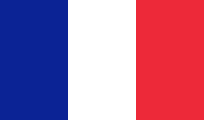
The flag of Paraguay (Spanish: bandera de Paraguay) was first adopted in 1842. Its design, a red–white–blue triband, was inspired by the colours of the French Tricolour, believed to signify independence and liberty. The flag is unusual because it differs on its obverse and reverse sides: the obverse of the flag shows the national coat of arms, and the reverse shows the seal of the treasury. It was revised in 2013 to bring the flag towards its original design. It has a ratio of 11:20. The colours of the flag are believed to be inspired from the flag of France to show independence and liberty, and the coat of arms represents the independence of Paraguay. The emblem on the reverse side is the seal of the treasury: a yellow lion below a red Phrygian cap on the top of a pole (symbolising courage) and the words Paz y Justicia ('Peace and Justice'). The differences in the obverse and reverse sides comes from the period when José de Francia was in power (1814–1840). On July 15, 2013, the flag was revised. The coat of arms was simplified and the design was brought closer to its original form. (Source: Wikipedia.org, CC BY-SA)
The flag of Peru was adopted by the government of Peru in 1824, and modified in 1950. According to the article 49 of the Constitution of Peru, it is a vertical triband with red outer bands and a single white middle band. Depending on its use, it may be defaced with different emblems, and has different names. Flag day in Peru is celebrated on 7 June, the anniversary of the Battle of Arica. (Source: Wikipedia.org, CC BY-SA)
The flag of Suriname was legally adopted on 25 November 1975, upon the independence of Suriname. The flag was designed as a result of a national competition. It was raised for the first time on the Independence Day of the Republic of Suriname. There is a legal requirement for vessels to raise the flag of Suriname when visiting another country to reduce miscommunication between other countries. The flag of Suriname is composed of five horizontal bands of green (top, double width), white, red (quadruple width), white, and green (double width) with a large, yellow, five-pointed star in the center. The color red represents progress, white represents freedom and justice and the green represents the fertility of the land. The yellow star represents unity and a golden future. (Source: Wikipedia.org, CC BY-SA)
The flag of Trinidad and Tobago was adopted upon independence from the United Kingdom on 31 August 1962. Designed by Carlisle Chang (1921–2001), the flag of Trinidad and Tobago was chosen by the independence committee of 1962. Red, black and white symbolise fire (the sun, representing courage), earth (representing dedication) and water (representing purity and equality). (Source: Wikipedia.org, CC BY-SA)
The national flag of Uruguay (Spanish: Pabellón Nacional) is one of the three official flags of Uruguay along with the flag of Artigas and the flag of the Treinta y Tres. It has a field of nine equal horizontal stripes alternating white and blue. The canton is white, charged with the Sun of May, from which 16 rays extend, alternating between triangular and wavy. The flag was first adopted by law on 18 December 1828, and had 19 alternating stripes of white and blue until 11 July 1830, when a new law reduced the number of alternating stripes to nine. The flag was designed by Joaquín Suárez. The horizontal stripes on the flag represent the nine original departments of Uruguay, based on the U.S. flag, where the stripes represent the original 13 colonies. The first flag designed in 1828 had 9 light blue stripes; this number was reduced to 4 in 1830 due to visibility problems from distance. The stripes of blue and white were inspired by the flag of Argentina, making the flag of Uruguay part of both the Stars and Stripes and Belgrano flag families. The golden Sun of May represents the May Revolution of 1810; the Sun of May is a figurative sun that represents Inti, the sun god and mythological founder of the Incan Empire. It also appears in the Flag of Argentina and the Coat of Arms of Bolivia. (Source: Wikipedia.org, CC BY-SA)
The current eight stars flag of Venezuela was introduced in 2006. The basic design includes a horizontal tricolour of yellow, blue, and red, dating to the original flag introduced in 1811, in the Venezuelan War of Independence. Further modifications have involved including a set of stars, multiple changes to the placement and number of stars and inclusion of an optional coat of arms at the upper-left corner. (Source: Wikipedia.org, CC BY-SA)

Time for recess! Post a comment, ask a question or write a review. Feel free to let us know what you think!
I want to get the greek driving license, so should i study from here and thats it for the oral exam ? thanks a lot
 0
0


Complete solutions and walkthroughs for all Brain Test game levels. Get step-by-step guides and video tutorials to solve every tricky puzzle.https://braintest.games/
-1
According to Article 14 this diagram is incorrect. You stay in the inside lane unless you are coming off at the FIRST exit only.
3
Aerial Silks, Aerial Yoga Hammock all in over 46 colors. Of No-low and Low-medium Stretch Silks. Aerial Lyra, Hardware and more! Build your response time with Aerials www.aerialsusa.com
1

Speedlimit signs in Norway are not just at the start of the speedlimit. Every speedlimit sign exept 50 and 80 are also placed with a specific distance between eachother as a reminding. If there is no speedlimit sign for a while, you are either in a 50 or 80 area, depending on the road and amout of houses/buildings
1
Most of these DOES NOT exist on the official Greek test. //Someone that not only practiced it in Greece, but also scraped sites that had the official test (1:1 copy to the official one) in order to build a better learning site than existing ones (still a work in progress).
-1
I think the wording is a bit unlucky. "Warning for cyclists" is wrong. It's a "Warning OF cyclists FOR everybody". I think all those "Warning for X" signs should be "Warning of X" or "Warning against X". And then it's not really as specific as some of them are described. E.g. there's one that says "Warning for deer", which should be "Warning against wildlife crossing". It's not deer, it could be warthogs or boars or foxes as well.
Traffic signs in Portugal follow European standards, using clear symbols and colors. They regulate speed, directions, and warnings https://bomcondutor.com.pt/ . Understanding them is essential for safe driving and avoiding fines or accidents.
0
This is a solid breakdown. But honestly, road safety starts with knowing the basics. Check this out for some cool tech related to it—might be worth a look: https://www.ainanobanana.pro
1
Driving tips are crucial, but people often forget the fun side of road trips. A good way to unwind is to play games while waiting in traffic, like maybe this cute puzzle game. <a href="https://chiikawapuzzle.art"; target="_blank">chiikawa puzzle</a>
0
Super useful for reviewing the driving code in Japan! I hope it will help me remember all the signs. Good luck to everyone taking the exam and play the https://sprunkiretake.io
0
This looks useful for studying! I hope it helps me not panic on the day of the exam. Fingers crossed for https://buzzcut.style!
1
Lot of info here, but I gotta say, knowing the right tire pressure is a game changer. Keeps your ride smooth and safe—check out this tool for some handy pixel art that might spark your creative side too. https://www.wplace.pro
0
To sum-up: A-3 and A-4 are wrong - the sign only tells you the direction of the first curve, the second one can be whatever A-6d and A-6e are not about sharpness, but about the incoming roads being one-way towards the road you're currently on A-18a is not about cattle specifically, but about farm animals or domesticated animals A-18b is not limited to deer, but any wild animals that might suddenly appear on the road, like elk or boars B-32a is literally "border control", but may also have different variations with different text meaning in general "stop here until you're explicitly allowed to go" All that info can be found on wikipedia.
2
A-4 also wrong. It means "dangerous curves — first to the left", the second one can be either left or right. It doesn't specify.
1
Wrong. This is A-6d, which "entry of the one-way road from the right". Nothing about sharpness. See: https://en.wikipedia.org/wiki/Road_signs_in_Poland
0
The questions are pretty good, but unfortunately there's no variety at all. Would be nice if there were questions about things other than the signs, which are arguably one of the easiest parts of traffic rules
2
If you don’t wear a seatbelt, you’re just asking for trouble. Plus, knowing how to handle slippery roads is crucial, or you’ll end up in a ditch. For those who enjoy homegrown food, check this out for some cool garden-to-table ideas. https://www.growagardenrecipes.pro
0
Look, safety on the road is no joke. All that talk about seatbelts and tire pressure? Spot on. But hey, if you're into photography too, check out this neat tool for some cool filters. Could make your car pics pop a bit more, ya know? https://www.digitalcamerafilter.art
0
A lot of good info here, but let's be real—nobody thinks about tire pressure until it's too late. By the way, if you're looking for something to get those creative juices flowing, check out this :https://www.my-doodle.art
-1
Look, all this stuff is basic driving knowledge. But seriously, if you're gonna drive, at least know when to ditch the old-school habits. Check out this game to blow off some steam after a long drive, it’s got some epic battles <a href="https://www.animefinalstrike.org"; target="_blank">animefinalstrike</a>.
-1
The polish sign "Curve of the main road" is actually a complimentary sign showing the "actual course of priority road" and there are several thousand variations of it as this is often "crossroad specific"
1
This goat is so beautiful! Living in the wild makes it look a bit thin. You can check out my website about whatsmyname的.https://whatsmynameapp.net/
1




 Dec 18, 2025

More community