

Here you can study for the exam. Look up keywords and learn definitions about all kind of subjects.
More subjects
The Turkish Angora (Turkish: Ankara kedisi, 'Ankara cat') is a breed of domestic cat. Turkish Angoras are one of the ancient, natural breeds of cat, having originated in central Anatolia (modern-day Turkey, Ankara region). The breed has been documented as early as the 17th century. Outside of the United States, the breed is usually referred to as simply the Angora or Ankara cat. Like all domestic cats, Turkish Angoras descended from the African wildcat (Felis lybica). Their ancestors were among the cats that were first domesticated in the Fertile Crescent. (Source: Wikipedia.org, CC BY-SA)
The Turkish Van (pronounced Von) is a naturally occurring breed of domestic cat that originated in the Lake Van area of modern-day Turkey, part of Armenian Highlands. The Van is classified as a semi-long hair, but it has two lengths of hair, determined by season. In the winter, the hair is thick and long. In the summer, the hair sheds to leave a short light coat. Both coat lengths are typified as being as soft as cashmere, down to the root. There is no evident undercoat on the Van, only one coat. The breed is rare, and is distinguished by the Van pattern (named after the breed), where the color is restricted to the head and the tail, and the rest of the cat is white; this is due to the expression of the piebald white spotting gene, a type of partial leucism.: 148 A Turkish Van may have blue or amber eyes, or be odd-eyed (having one eye of each colour). The breed has been claimed to be descended from the landrace of usually all-white Van cats, mostly found near Lake Van. The Western preference for matching eyes in the Van cat is a source of amusement to the people of the Lake Van region. (Source: Wikipedia.org, CC BY-SA)
 © Wikimedia.org/Louiethe27th, CC BY-SA
The Ukrainian Levkoy (Ukrainian: Український левкой) is a cat breed of distinct appearance, having inward-folding ears and little to no hair. These cats are of medium size with a longish body, appearing both muscular and slender. They have soft, elastic skin; an excess of which leads to a wrinkled appearance. The breed is not recognized by any major, international cat fancier and breeder organizations, only Ukrainian and Russian clubs. The Levkoy's peculiar features are: special angular contour of its head and 'stepped' profile (dog-face appearance), folded ears and large, but not wide almond-shaped eyes. The cats express sexual dimorphism. (Source: Wikipedia.org, CC BY-SA)
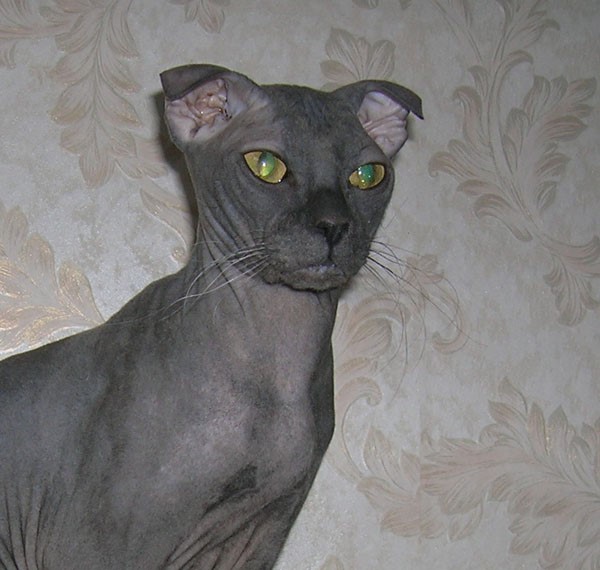 © Wikimedia.org/Alena Ivanchuk, CC BY-SA
The Van cat (Turkish: Van kedisi; Western Armenian: Վանայ կատու, romanized: Vana gadu; Eastern Armenian: Վանա կատու, romanized: Vana katu; Kurdish: pisîka Wanê) is a distinctive landrace of the domestic cat found in the Lake Van area of the Armenian Highlands in Turkey. Van cats are relatively large, have a chalky white coat, sometimes with ruddy coloration on the head and hindquarters, and have blue or amber eyes or have heterochromia (one eye of each colour). The variety has been referred to as 'the swimming cat', and has been observed to swim in Lake Van. (Source: Wikipedia.org, CC BY-SA)
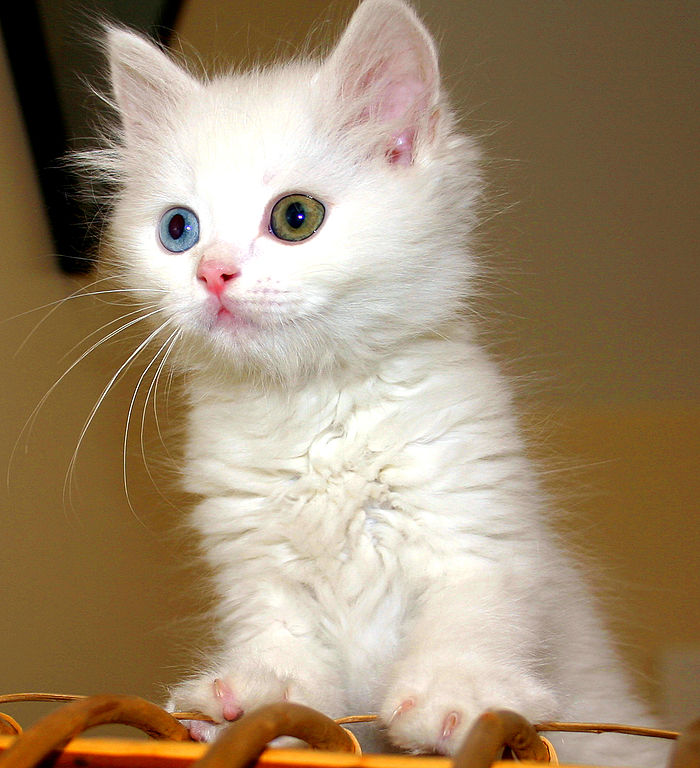 © Wikimedia.org/Bertilvidet, CC BY-SA
The York Chocolate (or simply York) was an uncommon American breed of show cat, with a long, fluffy coat and a tapered tail and most of them were mostly or entirely chocolate-brown or the dilute form of brown, known as lavender. The breed was named after New York state, where it was established in 1983. This breed was created by color-selecting domestic long-haired cats of mixed ancestry. The breed was not widely recognized by cat registries. It was not recognized by the major organizations such as The International Cat Association (TICA), the Cat Fanciers' Association (CFA – North America) or Fédération Internationale Féline (FIFe - Europe). By 2015 there was only one listed breeder of York Chocolates (Debbie Reber). By 2016, no registry carried its breed standard, there were no breeder websites and the breed is considered extinct. Although similar looking random-bred cats can be found today, without pedigree papers these are not York Chocolate cats. (Source: Wikipedia.org, CC BY-SA)
 © Wikimedia.org/Nickstein00, CC0

Time for recess! Post a comment, ask a question or write a review. Feel free to let us know what you think!

I want to get the greek driving license, so should i study from here and thats it for the oral exam ? thanks a lot
 0
0



Complete solutions and walkthroughs for all Brain Test game levels. Get step-by-step guides and video tutorials to solve every tricky puzzle.https://braintest.games/
-1

According to Article 14 this diagram is incorrect. You stay in the inside lane unless you are coming off at the FIRST exit only.
3

Aerial Silks, Aerial Yoga Hammock all in over 46 colors. Of No-low and Low-medium Stretch Silks. Aerial Lyra, Hardware and more! Build your response time with Aerials www.aerialsusa.com
1

Speedlimit signs in Norway are not just at the start of the speedlimit. Every speedlimit sign exept 50 and 80 are also placed with a specific distance between eachother as a reminding. If there is no speedlimit sign for a while, you are either in a 50 or 80 area, depending on the road and amout of houses/buildings
1
Most of these DOES NOT exist on the official Greek test. //Someone that not only practiced it in Greece, but also scraped sites that had the official test (1:1 copy to the official one) in order to build a better learning site than existing ones (still a work in progress).
-1

I think the wording is a bit unlucky. "Warning for cyclists" is wrong. It's a "Warning OF cyclists FOR everybody". I think all those "Warning for X" signs should be "Warning of X" or "Warning against X". And then it's not really as specific as some of them are described. E.g. there's one that says "Warning for deer", which should be "Warning against wildlife crossing". It's not deer, it could be warthogs or boars or foxes as well.
Traffic signs in Portugal follow European standards, using clear symbols and colors. They regulate speed, directions, and warnings https://bomcondutor.com.pt/ . Understanding them is essential for safe driving and avoiding fines or accidents.
0

This is a solid breakdown. But honestly, road safety starts with knowing the basics. Check this out for some cool tech related to it—might be worth a look: https://www.ainanobanana.pro
1
Driving tips are crucial, but people often forget the fun side of road trips. A good way to unwind is to play games while waiting in traffic, like maybe this cute puzzle game. <a href="https://chiikawapuzzle.art"; target="_blank">chiikawa puzzle</a>
0

Super useful for reviewing the driving code in Japan! I hope it will help me remember all the signs. Good luck to everyone taking the exam and play the https://sprunkiretake.io
0
This looks useful for studying! I hope it helps me not panic on the day of the exam. Fingers crossed for https://buzzcut.style!
1
Lot of info here, but I gotta say, knowing the right tire pressure is a game changer. Keeps your ride smooth and safe—check out this tool for some handy pixel art that might spark your creative side too. https://www.wplace.pro
0

To sum-up: A-3 and A-4 are wrong - the sign only tells you the direction of the first curve, the second one can be whatever A-6d and A-6e are not about sharpness, but about the incoming roads being one-way towards the road you're currently on A-18a is not about cattle specifically, but about farm animals or domesticated animals A-18b is not limited to deer, but any wild animals that might suddenly appear on the road, like elk or boars B-32a is literally "border control", but may also have different variations with different text meaning in general "stop here until you're explicitly allowed to go" All that info can be found on wikipedia.
2
A-4 also wrong. It means "dangerous curves — first to the left", the second one can be either left or right. It doesn't specify.
1
Wrong. This is A-6d, which "entry of the one-way road from the right". Nothing about sharpness. See: https://en.wikipedia.org/wiki/Road_signs_in_Poland
0

The questions are pretty good, but unfortunately there's no variety at all. Would be nice if there were questions about things other than the signs, which are arguably one of the easiest parts of traffic rules
2
If you don’t wear a seatbelt, you’re just asking for trouble. Plus, knowing how to handle slippery roads is crucial, or you’ll end up in a ditch. For those who enjoy homegrown food, check this out for some cool garden-to-table ideas. https://www.growagardenrecipes.pro
0
Look, safety on the road is no joke. All that talk about seatbelts and tire pressure? Spot on. But hey, if you're into photography too, check out this neat tool for some cool filters. Could make your car pics pop a bit more, ya know? https://www.digitalcamerafilter.art
0
A lot of good info here, but let's be real—nobody thinks about tire pressure until it's too late. By the way, if you're looking for something to get those creative juices flowing, check out this :https://www.my-doodle.art
-1
Look, all this stuff is basic driving knowledge. But seriously, if you're gonna drive, at least know when to ditch the old-school habits. Check out this game to blow off some steam after a long drive, it’s got some epic battles <a href="https://www.animefinalstrike.org"; target="_blank">animefinalstrike</a>.
-1
The polish sign "Curve of the main road" is actually a complimentary sign showing the "actual course of priority road" and there are several thousand variations of it as this is often "crossroad specific"
1
This goat is so beautiful! Living in the wild makes it look a bit thin. You can check out my website about whatsmyname的.https://whatsmynameapp.net/
1
What a lively walking crab! Its sideways scuttle is so full of character—like a tiny, determined navigator on a mission.https://animefinalstriketier.com/
1






 Dec 12, 2025










More community